If you’re exploring a career in fitness, you’ve almost certainly come across both terms, fitness instructor and personal trainer, used interchangeably online. They’re not the same qualification, and they don’t qualify you to do the same job. Understanding the difference matters, because it determines which course you enrol on, how long it takes, what you’re legally and professionally able to do with clients, and ultimately how much you can earn.
This guide breaks down exactly what separates the two, so you can choose the right starting point for your fitness career in Malta.
The Short Answer
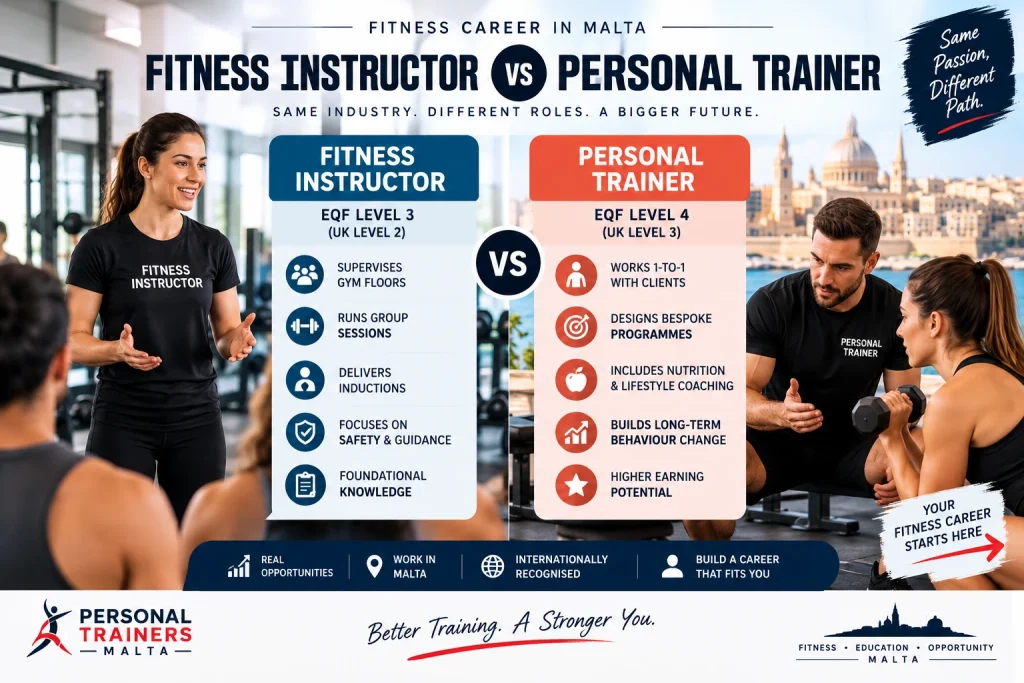
A Fitness Instructor, qualified at EQF Level 3 and roughly equivalent to UK Level 2, is qualified to supervise gym floors, guide members through general workouts, run inductions, and deliver group-based sessions. A Personal Trainer, qualified at EQF Level 4 and roughly equivalent to UK Level 3, is qualified to work one-to-one with clients, carry out in-depth consultations and assessments, and design fully bespoke training programmes.
Crucially, the Personal Trainer qualification builds on top of the Fitness Instructor one. You can’t skip straight to Personal Trainer level without holding, or completing alongside it, a recognised Fitness Instructor qualification first.
Fitness Instructor: What the Role Actually Involves
A Fitness Instructor is often the first professional role someone takes in the gym industry, and it’s a genuinely valuable qualification in its own right, not just a stepping stone. The training prepares you to supervise and support members using gym equipment safely, deliver general fitness inductions for new gym members, lead group exercise sessions and general workout guidance, understand foundational anatomy, physiology, and health and safety in a fitness environment, and conduct basic client consultations.
The typical course length is around 10 weeks, with a typical Malta course cost for 2026 of around €1,250. Graduates typically work in commercial gyms, leisure centres, hotel fitness facilities, and anywhere with a gym floor that needs supervision.
If you’re brand new to the fitness industry, this is almost always where your journey starts. Our full breakdown on how to become a personal trainer in Malta walks through exactly how the Fitness Instructor stage fits into the bigger picture.
Personal Trainer: What the Role Actually Involves
The Personal Trainer qualification is where the real earning potential and career flexibility start to open up, because it qualifies you to work directly and exclusively with individual clients. The training covers conducting detailed client consultations and fitness assessments, designing fully personalised training programmes based on individual goals, lifestyle and medical history, understanding nutrition principles and lifestyle coaching at a deeper level, encouraging sustained behaviour change rather than just single-session workouts, and applying business and professionalism skills specific to one-to-one client relationships.
The typical course length is around 12 weeks on top of your Fitness Instructor qualification, with a typical Malta course cost for 2026 of around €1,650. Graduates typically work in gyms and studios as one-to-one coaches, in private or mobile personal training, or as self-employed business owners.
If you want the full financial picture of what this level of qualification typically leads to, our guide on personal trainer salary in Malta covers realistic earning expectations for both employed and self-employed trainers.
How the Two Qualifications Compare
The qualification level tells much of the story on its own. A Fitness Instructor holds an EQF Level 3 qualification, equivalent to UK Level 2, while a Personal Trainer holds an EQF Level 4 qualification, equivalent to UK Level 3. Course duration runs to roughly 10 weeks for Fitness Instructor and roughly 12 weeks for Personal Trainer, assuming Fitness Instructor is already complete. In terms of client work, a Fitness Instructor typically supports groups and the general gym floor, while a Personal Trainer works one-to-one with fully personalised programmes. The typical working setting also shifts, from commercial gyms and leisure centres for Fitness Instructors to studios, private coaching and self-employment for Personal Trainers. And entry requirements differ too: Fitness Instructor requires only that you’re 18 or older with general fitness, while Personal Trainer requires a recognised Fitness Instructor qualification first.
Do You Need Both?
For most people who want a genuine, long-term fitness career, not just a part-time gym job, the answer is yes. Holding both qualifications gives you far more flexibility. You can supervise a gym floor for steady income while building your one-to-one client base on the side, or move straight into higher-earning personal training work once qualified.
Many training providers in Malta, including SteelExtreme Academy, offer a combined Fitness Instructor and Personal Trainer package, typically around 24 weeks and roughly €2,780 in 2026, which works out more cost- and time-efficient than doing the two qualifications separately at different points.
Which One Should You Choose First?
If you’re asking this question, the honest answer is that you don’t need to choose; you need to sequence. Nearly every accredited Personal Trainer course requires the Fitness Instructor qualification as a prerequisite, so the real decision isn’t “instructor or trainer,” it’s whether to complete them separately over time or together as a combined package.
If you want to start earning as quickly as possible, the Fitness Instructor qualification alone, at around 10 weeks, gets you employable sooner. If you’re set on eventually running your own client base, committing to the combined package from the start saves time and often money versus doing both later. And if you’re still unsure, starting with Fitness Instructor is a low-risk way to confirm you enjoy the industry before committing to the full Personal Trainer pathway.
Common Misconceptions Worth Clearing Up
A few misunderstandings come up repeatedly when people first compare these two qualifications. Some assume personal trainer is just a more advanced fitness instructor, but while Personal Trainer does build on Fitness Instructor knowledge, it’s a genuinely different skill set focused on individualised coaching, consultation, and programme design, rather than simply more of the same content at a harder level. Others believe they need to work as a fitness instructor for years before qualifying as a PT, when in reality many students complete both qualifications back to back, or as a combined package, without ever working full-time as a standalone fitness instructor first. And some assume fitness instructor qualifications aren’t worth much on their own, which isn’t accurate either, since it’s a fully recognised, employable qualification that opens the door to gym-based roles, with plenty of people building stable careers at this level without progressing further, particularly those who enjoy the group and floor-coaching side of the industry more than one-to-one work.
A Note on Accreditation, and Why It Matters for Either Qualification
Whichever level you’re pursuing, the accreditation behind the course matters just as much as the qualification title itself. In Malta, look for CIMSPA endorsement, the UK’s recognised professional body for the sport and physical activity sector, MFHEA approval, confirming the course meets Malta’s national education standards, and ICREPS or EREPS alignment, which allows you to register and work internationally rather than just locally.
A “Fitness Instructor” or “Personal Trainer” certificate without this backing may still teach you useful skills, but it can limit which gyms will hire you, whether insurers will cover you for one-to-one client work, and whether you can register to work abroad later. This is worth checking before comparing course prices, since the cheapest option isn’t always the one that actually opens doors.
Frequently Asked Questions
Can I become a personal trainer without first becoming a fitness instructor?
Generally no. A recognised Fitness Instructor qualification, or equivalent, is a standard entry requirement for Personal Trainer courses, since it covers the foundational anatomy, physiology and safety knowledge the Personal Trainer course builds on.
Which qualification pays more, fitness instructor or personal trainer?
Personal Trainers generally have higher earning potential, since one-to-one coaching commands premium rates compared to general gym floor supervision, though many trainers do both to maximise income.
How long does it take to complete both qualifications in Malta?
Around 24 weeks if studied as a combined package, though the online components allow most students to study part-time around existing work.
Is a fitness instructor qualification worth it on its own?
Yes. It’s a fully recognised, employable qualification in its own right, and a common route into gym-based roles even for those who later decide not to pursue Personal Trainer level.
Ready to Choose Your Path?
Whether you’re starting with Fitness Instructor, going straight for the combined package, or ready to progress to Personal Trainer level, explore our Course Options to compare pricing, duration and content side by side, or book a free discovery call to talk through which path fits your goals.