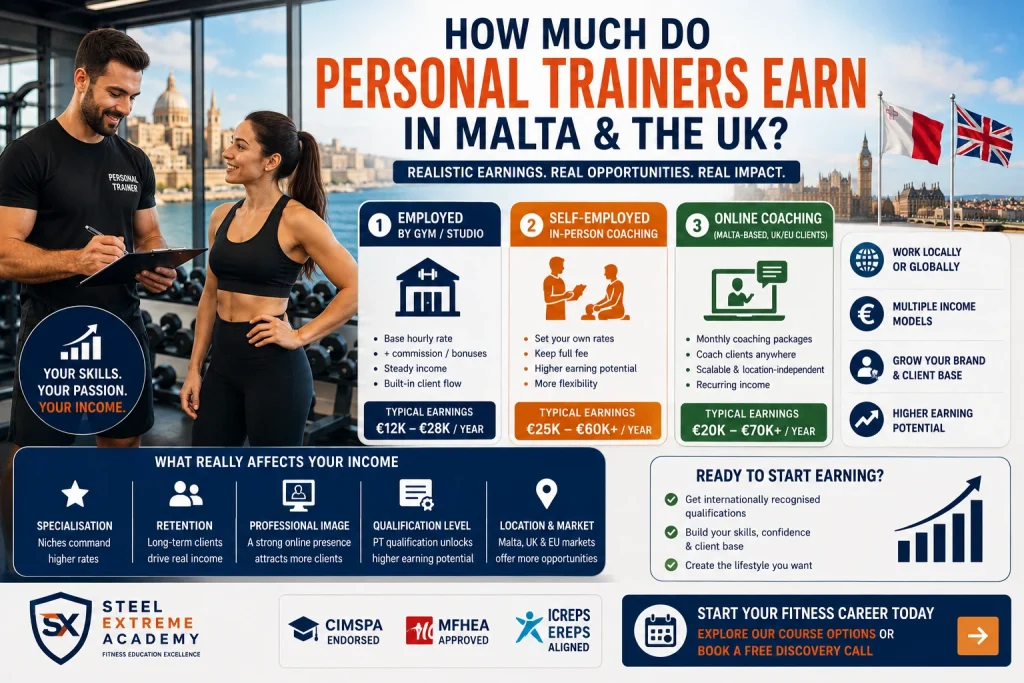
Of all the questions people ask before enrolling in a personal training course, “how much can I actually earn?” comes up more than almost anything else, and it’s also the question with the least straightforward answer. Unlike a salaried job, personal trainer income depends heavily on how you choose to work, not just how qualified or skilled you are.
This guide breaks down realistic earning expectations across the different working models available to Malta-qualified personal trainers, so you can go into the industry with numbers you can actually plan around.
Why There’s No Single “Personal Trainer Salary”
Unlike many professions, personal training rarely comes with a fixed salary band. Instead, income is shaped by a combination of factors, including your employment model, whether you’re employed by a gym or self-employed, your session rates, which are either set by the gym or by you, your client volume, meaning how many sessions you’re realistically delivering per week, your specialisation, whether that’s general coaching or a niche area like strength and conditioning or online coaching, and your location and market, whether that’s Malta’s local market or UK and EU clients coached online.
Because of this, it’s more useful to think in terms of income models rather than a single average figure.
Model 1: Employed by a Gym or Studio
This is the most common starting point for newly qualified trainers, and for good reason: it offers structure and steadier income while you build experience and a reputation. Typically, this means a base hourly or session rate paid by the gym, often supplemented with commission or bonuses for retained one-to-one clients, along with access to a built-in stream of gym members as potential clients, reducing the marketing burden.
The advantages are predictable income from day one and lower business risk, thanks to a built-in client pipeline. The downside is that earnings are capped by the gym’s rate structure, and you typically keep a smaller share per session than you would self-employed.
This route is often the most sensible first step after qualifying. Our guide on how to become a personal trainer in Malta covers how most students transition from certification into their first paid role.
Model 2: Self-Employed, In-Person Coaching
Once trainers have built confidence and a client base, often after a period working within a gym, many transition to self-employed, one-to-one coaching, either renting studio space, training clients outdoors, or offering mobile and home sessions. In this model, you set your own per-session or package rates, you keep the full session fee minus any space rental or equipment costs, and your income scales directly with how many clients you retain and how efficiently you fill your schedule.
The advantage is a significantly higher earning ceiling than employed roles, along with full control over pricing and client relationships. The downside is that income is inconsistent early on, and you’re responsible for all your own marketing, admin, and client acquisition, a business skill set that coaching qualifications alone don’t fully cover.
Model 3: Online Coaching (Malta-Based, UK/EU Clients)
This model has grown significantly among Malta-qualified trainers in recent years, largely because an internationally recognised qualification isn’t limited to the local market. Coaching clients remotely through programming apps, video check-ins, and messaging support removes the geographic ceiling entirely. Trainers typically charge monthly coaching packages rather than per-session rates, and one trainer can realistically support more clients than in-person coaching alone would allow, since sessions aren’t limited to physical availability. This model is often combined with in-person coaching for a blended, more resilient income stream.
The advantage is location-independent income and the ability to scale beyond Malta’s local client pool, with more predictable recurring revenue through monthly packages. The downside is that it requires strong self-marketing, usually through social media or referrals, and building trust remotely takes longer without in-person rapport.
What Actually Determines Your Income Level
Regardless of which model you choose, a few factors consistently separate higher-earning trainers from those who plateau. Specialisation matters a great deal, since trainers who develop a clear niche, such as strength and conditioning, post-injury rehab support, sports-specific coaching, or nutrition-inclusive coaching, tend to command higher rates than generalists. Retention over acquisition matters too, because long-term clients are far more valuable, and far cheaper to keep, than constantly chasing new sign-ups. Professional presentation also plays a role, as trainers who invest in a simple, clear online presence tend to convert enquiries into paying clients more consistently. And qualification level makes a real difference, since holding both Fitness Instructor and Personal Trainer qualifications, rather than Fitness Instructor alone, opens the door to significantly higher one-to-one rates, as it qualifies you for bespoke programming rather than just general gym supervision.
If you’re still deciding which qualification level unlocks which type of work, our comparison of fitness instructor vs personal trainer lays out exactly what each level qualifies you to charge for.
Realistic Timeline: When Does Income Stabilise?
Most newly qualified trainers, regardless of model, see a gradual, not immediate, ramp-up in income. In the first one to three months, you’re typically building initial clients, often through a gym’s existing membership base or personal network, so income is generally lower and less predictable. Between three and six months, a more consistent client base starts to form, particularly for trainers actively marketing themselves and asking for referrals. From six to twelve months and beyond, trainers who’ve combined solid coaching with consistent visibility, whether in-person reputation, online presence, or both, generally see income stabilise, and for self-employed trainers, begin to significantly outpace typical employed rates.
For a broader look at whether this income trajectory fits the lifestyle you’re picturing, see our guide on is a personal trainer career is worth it in Malta.
How Malta Compares to the UK Market
Since many Malta-qualified trainers coach clients internationally, it’s worth understanding how the two markets typically differ. UK-based one-to-one coaching, particularly in major cities, often commands higher per-session rates than the Malta market alone, but Malta’s lower cost of living and tight-knit client referral networks can offset that gap for trainers building a purely local business. Trainers who blend both, a Malta-based client base for in-person work plus UK or EU clients coached online, are often best positioned to capture the strongest aspects of each market: premium online rates alongside Malta’s low overheads and strong word-of-mouth culture.
Additional Ways Trainers Increase Their Earning Potential
Beyond the three core models above, many established Malta-based trainers add extra income streams once they’ve built a solid client base. Small group training, running sessions of two to four clients at once, lets you charge more collectively per hour than a single one-to-one session, without doubling your workload. Specialised workshops or challenges, such as a six-week transformation challenge, can attract clients who aren’t ready to commit to ongoing one-to-one coaching but want guided support. Continuing education and specialisation courses, whether in strength and conditioning, sports massage, or nutrition coaching, allow trainers to charge premium rates for higher-demand, higher-skill services. And referral partnerships with physiotherapists, nutritionists, or local businesses can create a steady, low-cost stream of new client referrals.
None of these require starting from scratch. They’re typically added on top of an existing client base once a trainer has some stability and reputation behind them.
Frequently Asked Questions
What’s the average personal trainer salary in Malta?
There’s no single fixed figure. Employed trainers earn a steady base rate plus session bonuses, while self-employed and online trainers with an established client base typically have significantly higher earning potential, though it varies by individual business model.
Do self-employed personal trainers earn more than employed ones?
Generally yes, once they’ve built a stable client base, since they keep the full session or package fee rather than a gym-set rate, though self-employment also carries more income variability, especially in the first few months.
Can Malta-qualified personal trainers earn from UK or EU clients?
Yes, provided your qualification is internationally recognised, meaning CIMSPA and ICREPS or EREPS-aligned, which allows you to coach clients online across the UK and Europe in addition to, or instead of, in-person work in Malta.
How long does it take for a new personal trainer to earn a stable income?
Most trainers see meaningful income stability somewhere between three and twelve months, depending on how actively they market themselves and how quickly they build client retention and referrals.
Ready to Start Earning as a Qualified Trainer?
The right qualification is the foundation for every income model above. Explore our Course Options or book a free discovery call with SteelExtreme Academy to find the path that fits the career and income you’re aiming for.